RepLon Greenhouse Management Platform
Overview
RepLon was developed as part of a Matching Fund research program to support melon greenhouse management for farmers in Blitar.
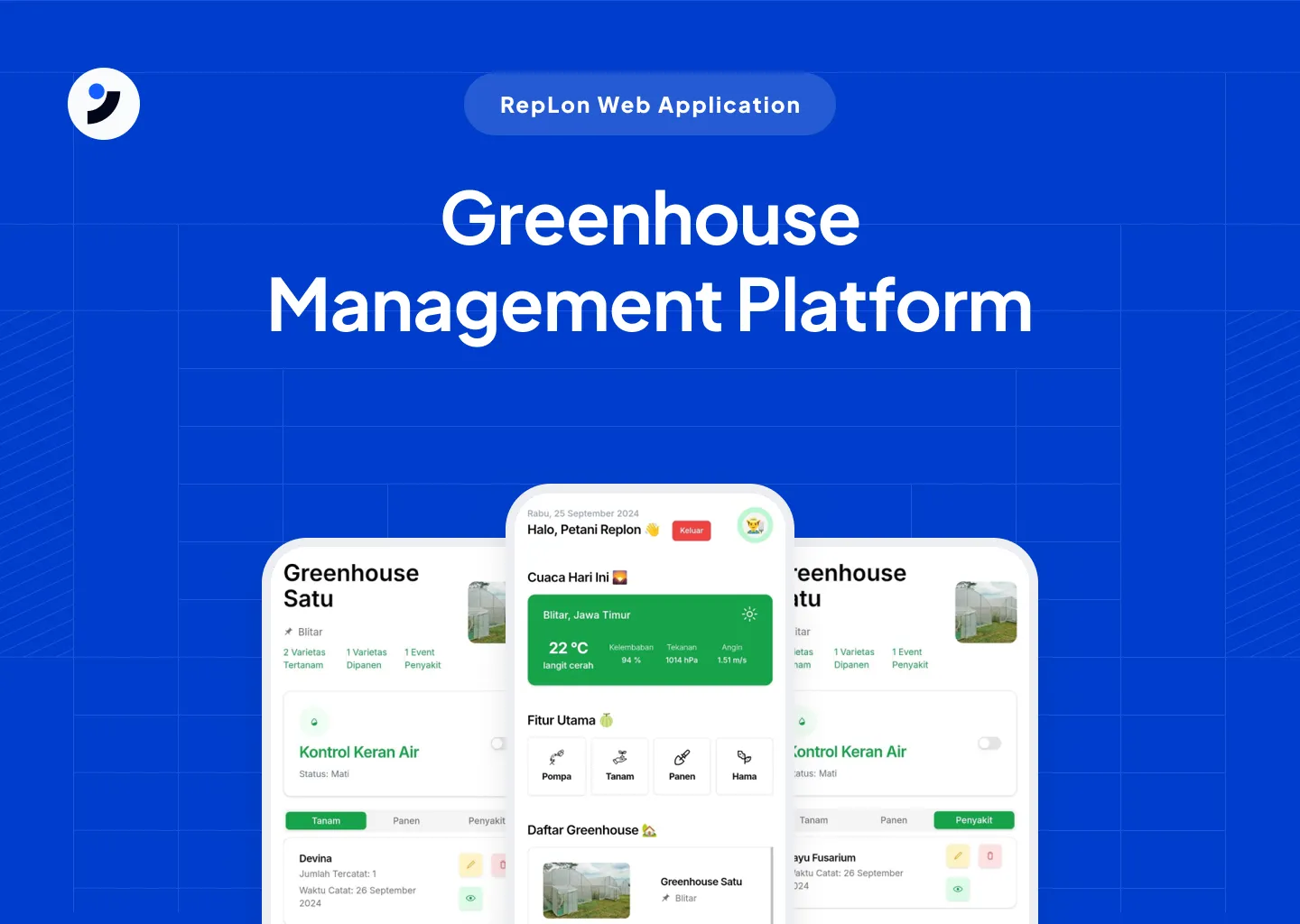
I contributed as a student researcher and web application developer. My primary responsibility was developing the farmer-facing web application, while working alongside lecturers and colleagues from data science and electrical engineering.
The application was designed to connect greenhouse management activities with digital monitoring and water pump control.
The Problem
Greenhouse operations involve more than monitoring environmental conditions.
Farmers also need to keep track of:
- Greenhouses and their locations
- Planted melon varieties
- Planting and harvesting activities
- Disease occurrences
- Water pump conditions and controls
RepLon aimed to bring these activities into one application that could be used directly by farmers.
Application Features
The application included:
- User authentication
- Greenhouse selection and management
- Planting activity records
- Harvest records and production quantities
- Disease event records
- Weather information
- Water pump status and controls
Each greenhouse page summarizes its location, planted varieties, harvested varieties, and recorded disease events.
Technical Implementation
The web application was developed using Next.js 14 and React, with the App Router used to organize features into routes such as greenhouse management, planting, harvesting, disease events, and pump controls.
Supabase was used for authentication and data management. The application retrieves greenhouse records, crop activities, harvest data, and disease events through database queries and stored functions.
The main technical flow was:
- Authenticate the farmer
- Retrieve greenhouses associated with the user
- Display greenhouse-specific operational records
- Allow the user to add planting, harvest, and disease events
- Send pump-control commands through application API routes
The pump interface displayed multiple pump nodes and allowed authorized users to check their current status and send commands to turn them on or off.
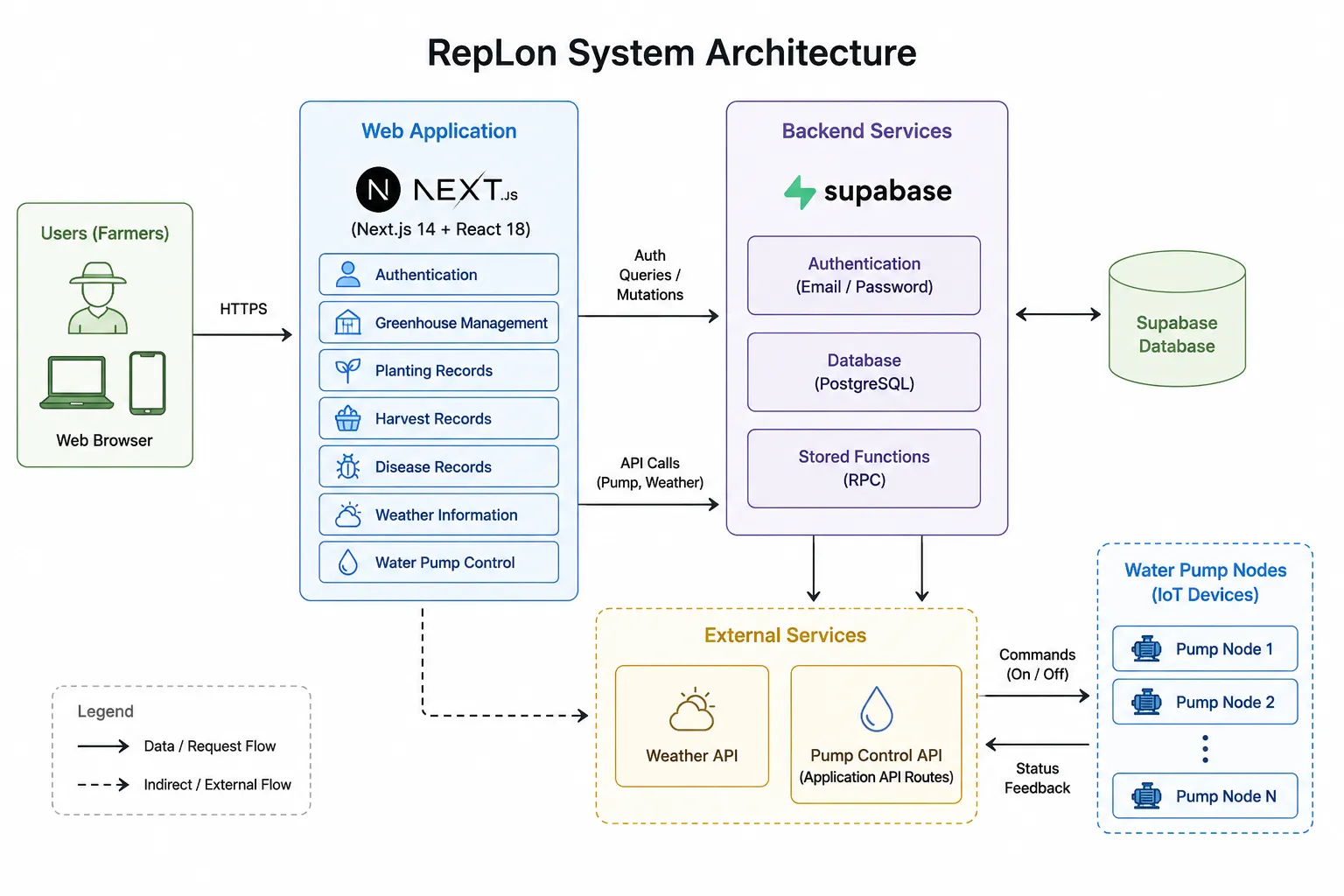
The primary technologies included:
- Next.js and React for the web application
- Supabase for authentication and database access
- Next.js API routes for pump and weather integration
- React Hook Form and Zod for form handling and validation
- Tailwind CSS and Radix UI for interface development
The hardware and embedded implementation were handled as part of the wider interdisciplinary research system and are not contained in this web repository.
My Role
I handled much of the web application development independently, including:
- Designing the application workflow
- Building farmer-facing pages and forms
- Integrating authentication and database operations
- Developing greenhouse activity records
- Implementing the water pump control interface
- Connecting the application to services developed by other disciplines
Although my work focused on software, the project required continuous coordination with teams working on IoT devices, data processing, and greenhouse infrastructure.
Field Experience
The most valuable part of RepLon was seeing the application outside the development environment.
Through field visits and direct engagement with farmers and the regional government of Blitar, I learned that real-world software cannot be designed only around ideal technical assumptions.
Connectivity, device availability, user familiarity, operational habits, and physical working conditions all affect whether a system is actually useful.
The experience changed how I approach software development:
A technically complete feature is not automatically a usable solution.
Current Status
RepLon was developed as a research prototype and is no longer actively maintained.
The repository represents the web application at the end of its active research period rather than a production-ready agricultural platform.
RepLon taught me that software becomes more meaningful when it is tested against real users, real environments, and real constraints.